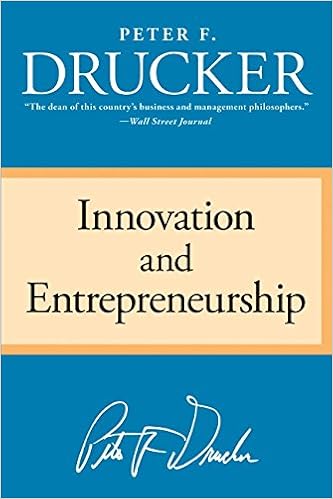
1) The general theme of Innovation and Entrepreneurship is that innovation and entrepreneurship need to become an integral part of organizations, the economy, and society. In the conclusion of his book, Drucker talks about innovation and entrepreneurship being the preferred change-agents in society because they are pragmatic (based on opportunity) rather than dogmatic (based on ideology). When we have a society that is based on opportunity, we have a society that rewards those who take advantage of those opportunities. By creating an entrepreneurial economy, we will have a better equipped (more knowledgable) work force and more fair society, because you need to have the right tools in order to take advantage of these opportunities.
2) Innovation and Entrepreneurship relates to what we're learning in class because Drucker writes about how innovation and entrepreneurship help society as a whole. In his book, Drucker claims that a society filled with entrepreneurs will take advantage of all opportunities that are out there. All entrepreneurs might not be successful, but those who do succeed will create a better society for everyone who lives in it. This is really what our class is about. Dr. Pryor taught us that the definition of entrepreneurship was "the process of creating value (make life better) by bringing together a unique combination of resources to exploit an opportunity". Dr.Pryor is teaching us how to take advantage of these opportunities, "creating value" for us and those around us. In class we are learning how to create value and the book is telling us how this will help society. Innovation and Entrepreneurship is an extension of what we are learning in class, and this is where the book and our class connect to one another.
3) If I were to design an exercise for this class based on the book, I think I would want everyone to think about the greater effect their idea will have on society. First I would have people think about who they are going to be helping. Then I would have everyone think about what the people they are going to help are dealing with now. Finally, I would have everyone think about what their target market's life is like after their idea is implemented. For instance, the idea I am working on is creating online presences for small businesses. Many small businesses are having to close down because of tough government restrictions on people shopping in-person. If every small business had an online presence, the amount of businesses closing right now would be "slim to none". People who work in retail stores wouldn't be losing their jobs because they can now sell to customers over the internet. By identifying the greater effect your idea will have on society, you can affirm that your opportunity exists and that you will be "creating value" for yourself and the people in your community.
4) The biggest "aha" moment I could identify in the book came when he connected the idea of an entrepreneurial society with something that Thomas Jefferson said. Towards the end of his life, Thomas Jefferson said "Every generation needs a revolution". During Jefferson's time, revolutions were drastic, had a lot of bloodshed, and really didn't solve the problem that they set out to solve. Drucker claims that in an entrepreneurial society, revolutions instituted incremental change, contain no bloodshed and always solve the problem they aim to solve. More specifically, Drucker writes " It is precisely because innovation and entrepreneurship are not 'root and branch' but 'one step at a time'... because they are not planned but focused... because they are tentative and will disappear if they do not produce the expected and needed result" (Drucker, 254). In an entrepreneurial society, we can get the changes that we need, not the changes that others think we need. This was an "aha" moment for me because I had never thought about revolutions like that. For instance, think about the American Revolution, it last roughly 20 years (from the first protests to the Treaty of Paris). Many were killed, and after it was done, we were left with a divided country (Federalists vs. Anti-Federalists). I'm not saying the American Revolution was bad, but if it was an entrepreneurial society, a lot of this could have been avoided: less bloodshed, quicker, etc. I've said this a million times, but if we lived in an entrepreneurial society, we could get the changes we need not the ones that others think we need.

No comments:
Post a Comment